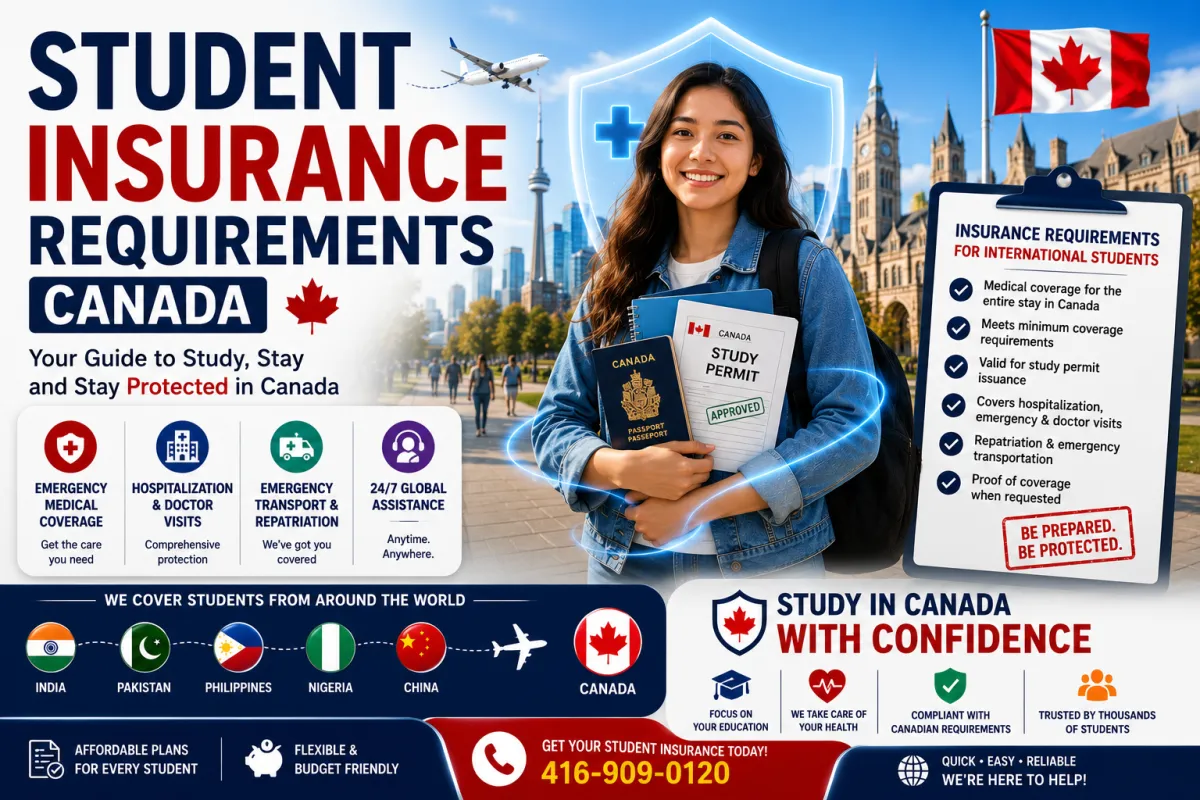
Student Insurance Requirements Canada 2026: Everything You Must Know Before You Study
Introduction: The Insurance Requirement Every Student in Canada Must Meet
Before you land in Canada — before you find your apartment, before you buy your transit pass, before you attend your first lecture — there is one requirement you cannot ignore: student insurance.
Understanding student insurance requirements in Canada is not optional. Canada's immigration authority (IRCC) requires all study permit holders to maintain adequate health coverage for the full duration of their stay. Getting this wrong doesn't just cost you money — it can affect your study permit application, your enrollment status at your institution, and leave you personally liable for medical bills that run into tens of thousands of dollars.
In 2026, a single uninsured night in a Canadian hospital can cost over CAD $3,700. An emergency appendectomy without coverage? Upward of CAD $20,000. These are not worst-case scenarios — they are documented costs that uninsured students in Canada face every year.
This complete 2026 guide to student healthcare Canada requirements covers:
The federal (IRCC) insurance requirement every student must meet
Province-by-province insurance rules — updated for 2026 across all 10 provinces
University-level requirements and what they mean for enrollment
What proof of insurance you actually need and when
The three coverage layers every student should have
How to meet all requirements without overpaying
Whether you are coming from India, Nigeria, the Philippines, China, the UAE, or anywhere else in the world — this is the definitive guide to what Canada actually requires from you.
The Federal Requirement: What IRCC Says About Student Insurance in Canada
Canada's federal immigration authority — Immigration, Refugees and Citizenship Canada (IRCC) — has a clear position on student insurance requirements in Canada:
All international students on study permits must maintain adequate health insurance for the entire duration of their stay in Canada.
This is not a suggestion. It is a condition of your study permit. What this means in practice:
You must have coverage that begins on or before your arrival date in Canada
Coverage must remain continuous — gaps are not acceptable
Coverage must match or exceed your study permit duration
You may need to provide proof of insurance as part of your study permit application, depending on your visa office
What Counts as "Adequate" Coverage?
IRCC does not specify a single plan name or provider. "Adequate" is interpreted as coverage that includes, at minimum:
Emergency hospitalization
Physician and specialist visits
Diagnostic tests (X-rays, lab work, MRI)
Medical evacuation and repatriation (strongly recommended)
Coverage that lasts the full duration of the study permit
Acceptable proof of insurance includes:
A UHIP enrollment confirmation letter (Ontario universities)
A Guard.me or Manulife policy certificate with matching coverage dates
An iMED enrollment confirmation (UBC, SFU students)
A private insurance policy document showing coverage period and benefits
Gaps in coverage can result in study permit complications or refusal at the border. Always ensure your policy start date aligns with your planned arrival date in Canada — not your first day of class.
University-Level Requirements: What Your Institution Demands
Beyond IRCC, every Canadian university and college has its own insurance requirements for international students. These are set independently by each institution and in many cases are stricter than the federal minimum.
Automatic Enrollment (Most Common)
The majority of Canadian universities automatically enroll all full-time international students in a health plan and add the premium to your tuition bill. This is the most common arrangement in 2026.
Examples:
Ontario universities (U of T, Waterloo, McMaster, Western, Queen's): Automatically enrolled in UHIP at CAD $684–$792/year
UBC, SFU (BC): Automatically enrolled in iMED for the 3-month MSP waiting period (~CAD $237)
McGill, Concordia (Quebec): Automatically enrolled in the institution's private health plan at CAD $800–$1,155/year
When you are auto-enrolled, your insurance requirement is met for primary medical coverage. However, you still need to review the plan carefully — auto-enrollment does not mean full coverage. Dental, prescriptions, and mental health are typically excluded from primary plans.
Opt-Out Window
Most universities allow students to opt out of the auto-enrolled plan if they have comparable private coverage elsewhere. This window is short — typically 2 to 4 weeks after the semester begins. Missing this window means you pay for the school plan regardless of what other coverage you hold.
If you have existing private coverage (for example, through a parent's employer plan or a policy purchased independently), confirm whether it meets your school's coverage requirements before attempting to opt out.
Proof of Insurance at Enrollment
Some institutions require you to submit proof of insurance as part of the enrollment process — not just at permit application stage. Have your policy document or plan confirmation ready before your first week.
Province-by-Province Student Insurance Requirements Canada (2026)
This is where Canadian student healthcare gets complex — and where most students make expensive mistakes. The rules vary dramatically by province. Here is the complete, verified 2026 breakdown.
Ontario — UHIP Mandatory; OHIP Excluded
Provincial coverage available? No — international students are not eligible for OHIP Required plan: UHIP (University Health Insurance Plan) Cost: CAD $684–$756/year (approximately CAD $57–$63/month), billed with tuition Waiting period: None — UHIP begins from enrollment date Who it covers: All full-time international students at Ontario universities and colleges
What UHIP covers: Medically necessary physician visits, hospital stays, emergency surgery, emergency care, diagnostic tests, specialist consultations — up to CAD $1,000,000 per policy year
What UHIP does NOT cover: Dental care, vision care, outpatient prescription drugs, ambulance fees, mental health counselling beyond physician-directed care
Supplemental plan required? Yes — student union extended health plan (~CAD $200–$400/year) for prescriptions, dental, and mental health
Study permit requirement: Programs of 12+ months (standard for most degree programs)
Key 2026 fact: Domestic students under 24 qualify for OHIP+ (free prescription drugs). International students are excluded from OHIP+ entirely and must cover prescriptions through UHIP supplemental or private plans.
British Columbia — MSP (Free But With a Waiting Period)
Provincial coverage available? Yes — for study permits of 6+ months Required plan during waiting period: Private bridge insurance (iMED, Guard.me, Manulife) Waiting period: Balance of arrival month + 2 full calendar months (~3 months total) MSP cost after waiting period: Free (premiums eliminated since January 2020) International Student Health Fee: CAD $75/month — billed separately, mandatory for MSP enrollees
What to do immediately on arrival in BC:
Apply for MSP online through Health Insurance BC — do this within your first week
Confirm bridge insurance is active (iMED auto-enrolled at UBC/SFU; purchase independently if at another institution)
Set a reminder for when MSP begins — coverage starts the balance of arrival month + 2 months
Register with a family doctor or walk-in clinic near your campus
Bridge insurance cost: iMED at UBC/SFU is approximately CAD $237 for 3 months. Guard.me/Manulife short-term plans average CAD $1.90–$2.50/day.
What MSP covers: Physician visits, hospital stays, emergency care, medically necessary diagnostics What MSP does NOT cover: Dental, vision, prescriptions, ambulance (CAD $80 for BC residents; CAD $530 for out-of-province)
Important: Under BC's Medicare Protection Act, eligible residents who decline MSP coverage cannot purchase private insurance as a replacement within the province. MSP enrollment is mandatory for eligible students.
Alberta — Most Generous; No Waiting Period
Provincial coverage available? Yes — AHCIP, free, no waiting period Requirement: Valid study permit; programs under 12 months may still qualify with a university letter confirming intention to remain 12+ months
What AHCIP covers: Physician visits, hospital care, emergency services, medically necessary diagnostics What AHCIP does NOT cover: Dental, prescriptions, vision, ambulance, physiotherapy
Supplemental plan cost: ~CAD $300/year through university student union plans
Alberta is the most straightforward province for student insurance requirements in Canada. If you have a 12-month study permit, register for AHCIP upon arrival and purchase supplemental coverage for dental and prescriptions. Total annual insurance cost: approximately CAD $300.
Quebec — Coverage Depends on Your Home Country
Provincial coverage available? Only for students from countries with a Quebec social security agreement Countries covered (2026): France, Belgium, Denmark, Finland, Greece, Luxembourg, Norway, Portugal, Romania, Sweden Plan: RAMQ (Régie de l'assurance maladie du Québec) — free for eligible students
For all other countries (India, China, Nigeria, Philippines, USA, Brazil, Mexico, Pakistan, and the majority of the world): You are not eligible for RAMQ and must purchase private or institutional insurance for your entire stay.
Institutional plans in Quebec (2025–2026 rates):
McGill University: ~CAD $1,155/year
Concordia University: ~CAD $800–$1,000/year
Université de Montréal: ~CAD $900–$1,100/year
Université Laval: ~CAD $800–$1,000/year
Total annual cost for ineligible students: CAD $1,000–$1,400/year (primary + supplemental)
Saskatchewan — Free Coverage, 3-Month Wait
Provincial coverage available? Yes — for study permits longer than 6 months Plan: Saskatchewan Health Waiting period: 3 months Cost: Free
What it covers: Physician visits, hospital stays, emergency care, diagnostics What it doesn't cover: Dental, vision, prescriptions
Purchase bridge insurance for the 3-month waiting period. Register through eHealth Saskatchewan upon arrival.
Manitoba — Free Coverage, 6-Month Wait
Provincial coverage available? Yes — but with a 6-month waiting period Plan: Manitoba Health Waiting period: 6 months (the longest provincial waiting period in Canada) Cost after waiting period: Free
During the 6-month waiting period: You must have private or university-provided health insurance. Budget approximately CAD $700–$1,100 for 6 months of private primary coverage.
Important 2026 note: Manitoba does not allow international students to access OHIP-equivalent public coverage like Ontario. The 6-month gap is significant — do not arrive without a confirmed private policy.
New Brunswick — Free Basic Coverage, 12-Month Permit Required
Provincial coverage available? Yes — with a 12-month study permit and full-time registration at a post-secondary institution Plan: New Brunswick Medicare Cost: Free (basic coverage only) Registration: At a Service New Brunswick office upon arrival
What it covers: Basic medically necessary physician and hospital services What it doesn't cover: Dental, vision, prescriptions, mental health, extended paramedicals
Extended private coverage strongly recommended — university plans and private supplemental plans fill the gaps. Budget CAD $300–$500/year for supplemental.
Nova Scotia — No Provincial Coverage; Private Required
Provincial coverage available? No — MSI (Medical Services Insurance) does not cover international students Required plan: University health plan (mandatory at Dalhousie, Saint Mary's, NSCC, and other NS institutions) Cost: Approximately CAD $900–$1,100/year
Nova Scotia students must budget for full private institutional coverage. Supplemental plans for dental and prescriptions add approximately CAD $200–$400/year on top.
Newfoundland and Labrador — Eligible From Arrival
Provincial coverage available? Yes — for study permits of 12+ months Plan: Medical Care Plan (MCP) Waiting period: None — eligible from arrival Cost: Free (basic coverage)
MCP covers basic physician and hospital services. Extended health plans through your institution cover dental, prescriptions, and vision.
Prince Edward Island — 6 Months + Work Authorization Required
Provincial coverage available? Conditionally — students studying and living in PEI for 6+ months who have off-campus work authorization may apply for the provincial health card
Registration: Join the Provincial Patient Registry to access a family doctor or nurse practitioner. This is a separate step from the health card application.
For students not meeting the work authorization condition, private insurance is required for the full stay.
Northwest Territories — Coverage Available
Provincial coverage available? Yes — NWT Health Care (NWTHC) for eligible international students meeting study permit and enrollment requirements What it covers: Basic physician and hospital services What it doesn't cover: Dental, eyeglasses, prescription medications
Supplemental private coverage is essential for any student in the NWT.
The Three Layers of Student Healthcare Canada — What You Actually Need
No single plan covers everything. Every student in Canada in 2026 needs to think in three layers:
Layer 1: Primary Health Coverage (Mandatory)
Covers emergencies, hospitalization, physician visits, diagnostics.
This comes from:
Provincial plan (Alberta, BC post-wait, Saskatchewan, Manitoba post-wait, New Brunswick, Newfoundland)
University-administered plan (UHIP in Ontario, institutional plans in Quebec and Nova Scotia)
Private international student plan (for students ineligible for provincial coverage, or during waiting periods)
Layer 2: Extended/Supplemental Coverage (Strongly Recommended)
Covers what Layer 1 misses: dental, prescriptions, vision, physiotherapy, mental health.
This comes from:
Student union group health plan (most Canadian universities — fee included in student fees)
Private supplemental plan from insurers like Sun Life, Manulife, or Green Shield
Annual cost: CAD $200–$500/year depending on coverage level
Layer 3: Travel Coverage Within and Beyond Canada (Recommended)
Provincial plans typically only cover healthcare expenses inside that province. If you travel to another Canadian province or outside Canada during a school break, you may not be covered.
This comes from:
Short-term travel insurance for school-break trips
Annual multi-trip plans for students who travel frequently
Annual cost: CAD $50–$300/year depending on travel frequency
The Most Common Student Insurance Requirement Mistakes — and How to Avoid Them
❌ Mistake 1: Assuming Coverage Begins on Your First Day of Class
Coverage under most plans begins either at enrollment (UHIP) or on your policy start date. If you arrive in Canada days before your enrollment date or policy start, you have a gap. Purchase coverage that begins from the exact day you land.
❌ Mistake 2: Missing the Opt-Out Window
If you want to opt out of your university's automatic plan because you have private coverage, the window is typically 2–4 weeks after semester start. Miss it and you pay regardless.
❌ Mistake 3: Not Confirming Out-of-Province Coverage
Provincial plans cover healthcare in that province. If you travel to another province for a weekend trip or a break, your provincial card may not cover you — or may reimburse at much lower out-of-province rates. Always check portability before travel.
❌ Mistake 4: Letting Coverage Lapse Between Semesters
If your plan is academic-year-based, it may not cover the summer months between May and September. If you're staying in Canada over summer, confirm your coverage is active or purchase a bridge plan.
❌ Mistake 5: Undisclosed Pre-Existing Conditions
All Canadian insurers require full disclosure of pre-existing medical conditions. Failing to declare a condition — even one you consider minor — can void your entire claim when you need coverage most.
❌ Mistake 6: Not Registering for the Provincial Plan Immediately on Arrival
In BC and Saskatchewan, MSP and provincial health have waiting periods. Every day you delay your application is a day added to the gap. Register on arrival — Day 1, not Week 3.
❌ Mistake 7: Assuming School Plan Covers You Abroad
University and provincial plans do not cover medical expenses outside Canada. If you travel internationally during a school break, you need separate travel insurance for that trip.
Proof of Insurance Documents: What to Prepare
For your study permit application and your first week in Canada, have these documents ready:
How Student Healthcare Canada Works in Practice: A Day-to-Day Guide
Knowing your requirements is one thing. Knowing how to actually use your coverage is another.
Walk-In Clinics
Walk-in clinics are the fastest and most practical option for non-emergency care in Canada. Most accept UHIP, MSP, and other student plans. Always carry your insurance card. Some clinics ask you to pay upfront and submit a claim for reimbursement — keep all receipts.
Emergency Rooms
For genuine emergencies (chest pain, severe injury, difficulty breathing), go directly to the nearest hospital emergency department. Most hospitals bill your insurer directly for insured services. Non-insured services (private rooms, certain medications) may require upfront payment.
Pharmacies
Prescription drugs are not covered by provincial plans. At a pharmacy, present your student union supplemental plan card for drug coverage. If your plan covers 70–90% of prescription costs, you pay the remainder at the counter.
Mental Health Services
Campus counselling centres are free but often have waitlists of 4–8 weeks in major cities. Telehealth services (included in some 2026 supplemental plans) provide same-week or same-day access to mental health professionals. Check whether your plan includes direct telehealth access — not just physician referrals.
Claims Process
Receive treatment
Pay upfront if required (keep all receipts and documentation)
Submit claim online through your insurer's portal within the claim window (typically 90–180 days)
Reimbursement deposited directly to your Canadian bank account
Frequently Asked Questions: Student Insurance Requirements Canada
Q: Is health insurance mandatory for international students in Canada?
Yes. IRCC requires all study permit holders to maintain adequate health coverage for the duration of their stay. Additionally, most Canadian universities require proof of health insurance as a condition of enrollment. Being uninsured is not a legal option — and the financial consequences of a single uninsured medical event can be severe.
Q: What proof of insurance does Canada require for a study permit?
You may need to demonstrate that you have or will have adequate health coverage for your full stay. Acceptable proof includes a UHIP enrollment letter, a Guard.me or Manulife policy certificate, an iMED enrollment confirmation, or a private insurance policy document showing coverage dates and benefits that match your study permit duration.
Q: Do student insurance requirements in Canada differ by province?
Yes — significantly. Alberta provides free provincial coverage from arrival for most study permit holders. BC provides free coverage after a 3-month waiting period. Ontario provides no provincial coverage at all — UHIP is mandatory. Quebec covers only students from 10 specific countries. Nova Scotia has no provincial coverage for international students. Understanding your specific province's rules before you arrive is essential.
Q: What is the minimum coverage students need in Canada in 2026?
As a minimum, you need primary health coverage that includes emergency hospitalization, physician visits, diagnostic tests, and medical evacuation. The exact minimum varies by province and institution — but coverage starting below CAD $700,000 annually is generally considered insufficient for Canada.
Q: Can I use my home country's health insurance in Canada?
In most cases, no. Canadian healthcare providers and hospitals typically require a Canadian insurance plan, a provincial health card, or a recognized international student plan (UHIP, iMED, Guard.me). Home country policies are usually not accepted directly. Some policies offer reimbursement after the fact, but this requires you to pay upfront — which can mean thousands of dollars out of pocket in an emergency.
Q: What happens if my coverage lapses during my studies?
A coverage gap means you are personally responsible for all medical costs during that period. In some cases, it could also complicate your study permit renewal. Always renew or extend your plan before the current policy end date — set calendar reminders at least 30 days before expiry.
Q: Does student insurance in Canada cover travel between provinces?
Provincial health plans typically cover emergency care in other Canadian provinces, but at lower reimbursement rates than in-province care. Non-emergency services outside your home province are often not covered at all. For travel outside Canada, separate travel insurance is required.
Q: What are the student healthcare Canada requirements after graduation?
University and campus plans end at graduation. Provincial health coverage continues for basic physician and hospital services, but supplemental coverage (dental, prescriptions, mental health) stops. If you're transitioning to a PGWP (Post-Graduate Work Permit), there may be a gap before employer benefits begin. An interim private individual health plan bridges this period — individual plans start at approximately CAD $62/month for healthy young graduates.
Q: Do dependents of international students have their own insurance requirements?
Yes. Each dependent (spouse or child) must have their own individual coverage. They are not automatically covered under a student's UHIP or university plan. Private family plans are available — costs increase with each additional dependent. Budget accordingly before bringing family members to Canada.
How TravelersInsurances.ca Helps You Meet Every Requirement
Navigating student insurance requirements in Canada — across provinces, institutions, IRCC rules, and supplemental gaps — is genuinely complex. The cost of getting it wrong is high. The cost of getting expert advice is zero.
At TravelersInsurances.ca, a licensed Canadian insurance advisor will:
✅ Confirm exactly which requirements apply to your province and institution
✅ Identify coverage gaps in your existing school plan
✅ Compare private plan options from multiple providers
✅ Ensure your coverage start date aligns with your arrival date
✅ Help you prepare the proof of insurance documents you need
✅ Provide ongoing support if your study period extends or your situation changes
📞 Call: +1 416-909-0120 🌐 Get your free consultation: travelersinsurances.ca/student-travel-insurance-canada
Conclusion: Know the Requirements. Meet Them Before You Land.
Student insurance requirements in Canada in 2026 are not one-size-fits-all. They change based on your province, your institution, your study permit length, and your home country. But they are non-negotiable — for IRCC, for your university, and for your own financial protection.
The summary every student needs:
IRCC requires adequate health coverage for your full study permit duration
Your university requires enrollment in an approved health plan (often automatic)
Your province determines whether you access public healthcare, and when
Your coverage gaps (dental, prescriptions, mental health, travel) require supplemental insurance
Your arrival date must be covered — not just your first day of class
Sort your student healthcare Canada requirements before you travel. A licensed advisor can confirm everything you need in a single free consultation.
👉 Get expert help with student insurance requirements — TravelersInsurances.ca
Disclaimer: This article is for informational purposes only and does not constitute immigration, legal, or insurance advice. Student insurance requirements in Canada, provincial health plan rules, and institutional plan details are accurate as of June 2026 and are subject to change. Always verify current requirements with IRCC, your provincial health authority, and your institution before your departure. Consult a licensed insurance advisor for personalized recommendations.